Klaviyo Post-Purchase Flow: Turn Buyers into Repeat Customers
Quick answer: A Klaviyo post-purchase flow is the automated sequence that fires after someone places an order. It thanks the buyer, sets delivery expectations, helps them use the product, then cross-sells and requests a review — turning a one-time buyer into a repeat customer. Trigger the cross-sell portion on “Fulfilled” (not “Placed”), and a 7–14 day delay hits peak repeat-purchase intent.
Key takeaways
- Post-purchase is a retention goldmine — it fires when satisfaction and intent are highest.
- Trigger the cross-sell on order fulfilled, not placed, so people have the product before you pitch the next one.
- Use “bought X, not Y” logic — relevant recommendations make buyers up to 3× more likely to purchase again.
- Split first-time vs repeat buyers: new buyers need reassurance, repeat buyers want VIP perks.
- Post-purchase + replenishment flows often drive the highest cumulative LTV of any automation.
Most stores pour effort into acquiring the first order and then go quiet — which is exactly backwards. The cheapest revenue you’ll ever earn is the second order from someone who already trusts you. The Klaviyo post-purchase flow is how you systematically earn it. This is a cluster of our complete Klaviyo flows guide.
Why is the post-purchase flow a retention goldmine?
Because it reaches a customer at the rare moment when they’ve just paid you and are excited about the product. Satisfaction and brand affinity peak right after purchase and just after delivery. A well-built post-purchase flow uses that window to reduce buyer’s remorse, drive product usage (which reduces returns), and tee up the next purchase — all on autopilot.
The economics are compelling: acquiring a new customer costs far more than activating an existing one, so even a small lift in repeat rate compounds into meaningful LTV gains over a year.
When should the post-purchase flow send?
Timing is everything, and different parts of the flow have different clocks:
- Thank-you / what happens next: immediately after the order is placed.
- Product education / how-to: around delivery — trigger on “Fulfilled” or wait a few days so it lands when the box arrives.
- Cross-sell: 7–14 days after fulfillment. This is when the customer has used the product and is most receptive to a complementary one.
- Review request: after they’ve had time to form an opinion — typically 1–2 weeks post-delivery.
Triggering the cross-sell on fulfilled rather than placed is the single most common fix we make — pitching a second product before the first has arrived feels tone-deaf and converts poorly.
What goes in each post-purchase email?
The flow below shows the full structure, including the first-time vs repeat buyer split and the conditional exits that keep it relevant.
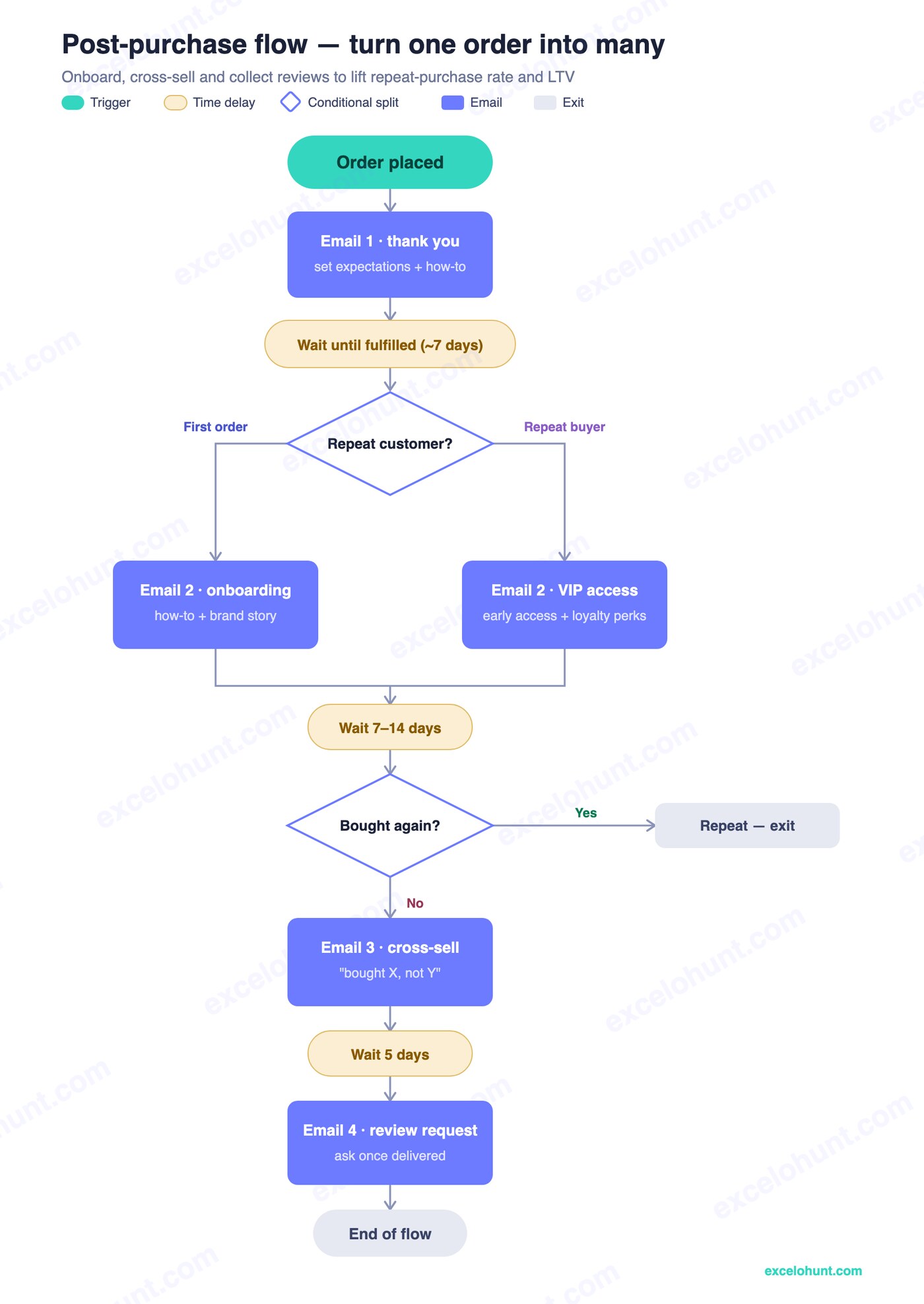
- Email 1 — Thank you + what’s next: confirm the order vibe (not the transactional receipt), set delivery expectations, and reduce anxiety.
- Email 2 — Onboarding or VIP: new buyers get how-to content and brand story; repeat buyers get early access or loyalty perks.
- Email 3 — Cross-sell: “bought X, not Y” recommendations of complementary products.
- Email 4 — Review request: ask for a review once they’ve had the product long enough to judge it.
Cross-sell and replenishment: driving the second order
The cross-sell email is where the repeat revenue lives. Make it relevant, not random — recommend products that genuinely complement what they bought (skincare → the matching serum; coffee → the grinder). Klaviyo’s product recommendations and your catalog data make this straightforward.
For consumable products, layer a replenishment nudge on top: estimate when the product runs out and remind the customer to reorder just before. Klaviyo AI can predict each customer’s next-order date, so the reminder lands at the right time instead of a generic interval. Cross-sell and replenishment together are the engine of strong customer LTV.
Asking for reviews the right way
Reviews are a free flywheel — they feed social proof back into your acquisition and your other flows. Two rules:
- Wait until they’ve used it. Asking the day the order ships gets you uninformed reviews; asking 1–2 weeks after delivery gets you useful ones.
- Make it one click. Link straight to the review form with the product pre-filled. Every extra step loses responses.
Sync those reviews into your welcome and cross-sell emails and the loop closes — social proof drives the next buyer.
Post-purchase benchmarks and what to measure
Judge this flow on repeat-purchase rate and revenue per recipient, not opens. Useful signals:
- Share of customers placing a second order within 60–90 days
- Cross-sell email conversion and revenue per recipient
- Review submission rate
- 90-day and 12-month LTV trend after turning the flow on
If repeat rate isn’t moving, the usual fixes are better cross-sell relevance, correcting the timing, and splitting first-time vs repeat buyers. When customers stop responding entirely, route them to your winback flow. Klaviyo’s post-purchase guidance covers the setup mechanics.
Frequently asked questions
When should a Klaviyo post-purchase flow send?
Send the thank-you immediately, product education around delivery, the cross-sell 7–14 days after fulfillment, and the review request 1–2 weeks post-delivery. Trigger the cross-sell on “Fulfilled,” not “Placed.”
What should a post-purchase email include?
A thank-you that sets delivery expectations, product education or onboarding, a relevant cross-sell using “bought X, not Y” logic, and a one-click review request. Split first-time vs repeat buyers for relevance.
Does the post-purchase flow increase customer lifetime value?
Yes. By driving the second order and feeding replenishment reminders, post-purchase and replenishment flows typically produce the highest cumulative LTV of any automation, because they fire at peak repeat-purchase intent.
How is cross-sell different from replenishment?
Cross-sell recommends complementary products (“bought a camera, here’s the bag”); replenishment reminds customers to reorder the same consumable before it runs out. Most stores benefit from both.
About the author
Ravinderpal Singh is the founder of Excelohunt, a Klaviyo-focused email & SMS agency that builds retention automation for ecommerce brands. The timing and structure here come from post-purchase flows we’ve shipped.
Want a retention engine that lifts LTV? Book a free Klaviyo audit and we’ll build your post-purchase and replenishment flows.
More in Klaviyo
- 12 Best Klaviyo Agencies in 2026 (Honest Comparison)
- Klaviyo Agency Pricing: What You Should Pay in 2026
- Optimite Alternatives: Klaviyo Email Agencies Compared (2026)
- How to Set Up Klaviyo: Complete Setup Guide (Step-by-Step)
- How to Use Klaviyo: A Beginner's Guide (2026)